Building on an article published by my good friend Sally Acton from Torque Solutions, “Employee Experience: Wants + Empathy = Clarity”. This is the second article in the series, the first can be found here. If you haven’t read the articles please do so, enjoy and get in touch if you have questions. @wernerSmit or @SallyActon
Building to Successful convergence: Article 2 – The People of Convergence
In article one we discussed the four convergence factors:
- Trust Building
- Trust Erosion
- Convergence Blockers
- and Convergence Enablers
It goes without saying that these factors are influenced by both human and non-human elements and that there are both elements within and elements outside of your control. To this point article two will focus on people and what we can do to help build our teams to a space of positive convergence. We will be drawing on our collective experiences working with our own teams, building teams for other businesses and having employees of our own.
People react differently depending on how they perceive and understand the information before them. Take the diagram below, to the left we see people and to the right we see the four convergence factors. Running in the middle is the Convergence line, above the line are Barriers to Convergence and below the line are Enablers to convergence. For this article, we focused our efforts on knowledge and information and how that affects teams, building to a point of convergence. In essence, information and how it is communicated has a direct impact on whether people are going to be convergence enablers or not. The real challenge lies with the information itself, which becomes more difficult the larger your business grows. Whilst you can never fully control the impact and human reaction, you can do a lot to make sure the information elicits a constructive reaction.

The Information Puzzle. Information is just that, a series of words strung together perhaps with some impactful imagery to convey a specific message or series of knowledge points. The better you design your information, the better you can control on which side of the line people fall. With any communication there is bound to be a degree of unknown, uninterpretable or missing information. Everyone reads differently, what is a piece of the puzzle for me could be a completely useless piece of information to you. The beautifully frightening thing about the human brain is that it is exceptionally good at solving puzzles, even when it doesn’t have all the pieces and this is where things get messy. Any communication is basically giving each and every person’s brain the same puzzle to solve but everyone solves it slightly differently. We also have to accept that we will always be faced with incomplete puzzles. Sometimes puzzles are incomplete because we designed the information poorly or we can’t give out all the pieces at once. Sometimes the pieces are all there but are misinterpreted because of peoples dispositions, language barriers or previous experiences. Regardless of why pieces are missing, some will always be missing and with missing pieces comes the potential for division.
Understanding the division in people and information. As we have seen before the introduction of information has a tendency to divide your people into those who will act as enablers of convergence and those who will act against it. While we have probably all experienced definite malicious intent to stop convergence form happening, this is generally quite rare in our experience. Most of the barriers are created subconsciously, most of the trust is eroded through thought not action on the part of a team member. Most often barriers to convergence and trust erosion are happening through fear and misunderstanding. There is also a lot to be said for prior experience. We know that we inherit the mistakes of previous leaders when we bring new people into teams, and that when they leave they leave with both our victories and our mistakes as part of their decision making frameworks. This means that how people go about solving their information puzzles is very much influenced by their knowledge, understanding, experience and personal dispositions.
Dealing with Information Puzzles solved above the line.
Information puzzles solved above the line are tricky depending on what type of person you are dealing with. In our experience much of the behavior is driven by fear and misunderstanding. “Above-Liners” also have a tendency to test their theories against teammates, which means their interpretations become part of the larger conversation. Mostly this is done in an effort to find proof that their interpretations are correct, a type of self-affirmation. This however affects the team’s communal understanding in varying degrees depending on how zealously the Above-Liner preaches their truth.
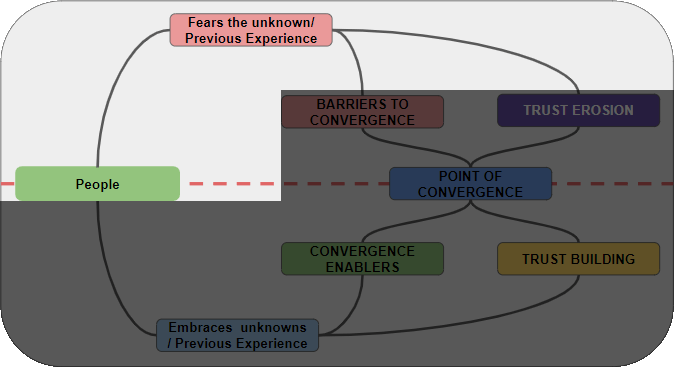
Take into account that fear could very well be a factor in their interpretation and decision making. As a leader you know they have it wrong, but they think they have it right. There is no reason to be hostile, going for an outright “you are wrong” is not going to bring the person below the line. In the end they will have the correct information but they are still above the line and might still be a barrier to convergence. The best way we found to deal with untangling a puzzle solved above the line is compassion and empathy. Listening to how the puzzle was solved, no matter how incorrectly you think it is, will give you all of the handles and hooks you need to help bring someone across the line. It also shows, through your action, that you have a definite interest in understanding the person and wanting them to understand the information. Trust building is a real job, we have to invest in understanding how people think in order to improve our next attempts at communicating.
Dealing with Information Puzzles solved below the line.
Information puzzles solved below the line are less tricky on face value but carry a much higher risk. Just remember being below the line doesn’t mean a person understands, it just means they are much more open to wanting to understand and enable a convergence. The Risk with Below-Liners is enthusiasm and trust, both easily broken or lost due to poor interaction from leaders. Remember these people already trust you and the information you have provided.
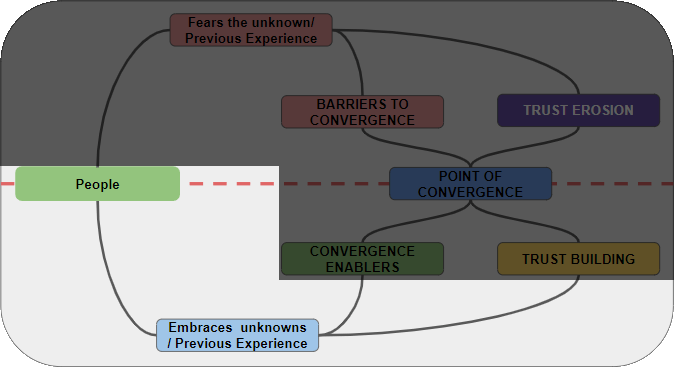
As with the Above-Liners so with the Below-Liners. As a leader you have to invest in understanding how they came to their solutions, and then helping them in the right direction, again showing with your actions that you have a definite interest in wanting them to understand. The positive thing about Below-Liners is that they are rarely fear driven, they have fear but it’s much more definable and as such it plays a lesser role in their interpretations and decision making. Below-Liners have the added benefit of wanting to understand and as such act less zealously in gathering different perspectives and vistas on the information at hand. This in turn has a much more positive impact on the communal understanding of the team.
Good information is built on five key areas:
- Accuracy – To be useful, all information must be of a high quality and be accurate at the time of being given.
- Completeness – No one works well with a small part of the picture, providing as much of the picture as possible. Obscuring parts of the information will lead to trust erosion as the bigger picture comes into focus later. If parts are missing or unknown, be transparent about that from the onset and provide timelines as to when it will be available.
- Consistency – Choose the channels that you will be communicating, the repositories for where previous communications sit, the style, tone and language to be used and stick to it. Channels can vary based on the information content and risk factors, that is to be expected, as well as the frequency.
- Uniqueness – What you are sharing must be different to what is already known. Take the COVID-19 situation, everyone understands that you must sanitise your hands, but what adds value and is unique, is how your company was going to be providing that sanitisation – would there be stations in the workplace? Would customers be made to sanitise before being allowed in etc.
- Timeliness – Information must be provided when it is going to add value to an employee. This does not mean that it is necessarily ‘good news only’ – because value adding can also be about pointing out potential issues so that employees can prepare.
Recap time!
- You will never be able to give all the information at once, especially if it’s a complex matter, always choose channels that are appropriate to the sensitivity and the risk of the information.
- Accept that people are driven by different dispositions and cater for investing in understanding how they put information together.
- Nib the stories in the bud. Address any mis information upfront and openly without turning it into a witch hunt, it’s important to be accurate not right. .
- Actions always speak louder than words, Below-Liners are always easier to deal with than Above-Liners but everyone is to be treated fairly. Your actions build and maintain trust.
- Use only high quality information – as they say in data management – $#@# in, $#@# out!
the path to convergence lies in accuracy. Invest in understanding the people around you so that your communications can be tailored and accurate.
 Mind, on the rocks?!